
At 03:45 UTC on February 28, v2.1.63 of Claude Code landed. Nineteen minutes later, GitHub issue #29504 appeared in the repository: two new slash commands were present in the binary and absent from the interactive-mode documentation. The commands were /simplify and /batch. Neither one appeared in the reference. Developers who found them through the issue, or through tab-completing in a live session, had no canonical description to consult.
I spent the morning tracing what I could confirm about each one. The results are asymmetric. /simplify has a clear lineage — Anthropic published the underlying logic as a plugin months ago, and the mechanics are documented. /batch has a name and a timing correlation with an open feature request. That asymmetry is the real story of v2.1.63, and the article below reflects it: more specificity on /simplify, deliberate restraint on /batch.
The Lineage Behind /simplify
The code-simplifier plugin exists in two forms in the Anthropic plugin marketplace. The standalone version is a single-purpose agent you install explicitly. The bundled version ships inside pr-review-toolkit, a multi-command package that combines review, commenting, and simplification workflows into one installation. Before v2.1.63, using either required navigating the marketplace, running an install command, and restarting the session.
The built-in /simplify removes that friction. The command is now present in every v2.1.63 installation without any action from the developer.
The plugin's manifest documents the behavior clearly enough that I can describe /simplify without guessing. It operates on Claude Opus — not the default Sonnet model — which means it's heavier and more expensive per invocation than a standard edit pass. It scopes exclusively to files modified in the current session. If you open Claude Code, touch three files over an hour of work, and then run /simplify, it reads those three files. It does not walk the repository. A file you modified yesterday in a previous session is not in scope.
Before it touches anything, the plugin reads your CLAUDE.md. The intent is that project-specific coding standards override generic defaults. If your CLAUDE.md specifies that your codebase uses CommonJS modules because of a legacy constraint, the command should respect that rather than converting everything to ES module syntax. Whether the built-in command implements this lookup identically to the installed plugin is not yet confirmed — the behavior is inferred from the plugin manifest, not from Anthropic's documentation of the built-in.
The conventions the plugin enforces when applied to JavaScript and TypeScript are specific. It prefers ES module syntax. It prefers the function keyword over arrow functions for named declarations. It requires explicit return types on function signatures. It disallows nested ternaries. These are not defaults that can be toggled through parameters at invocation — they are baked into the plugin's prompt.
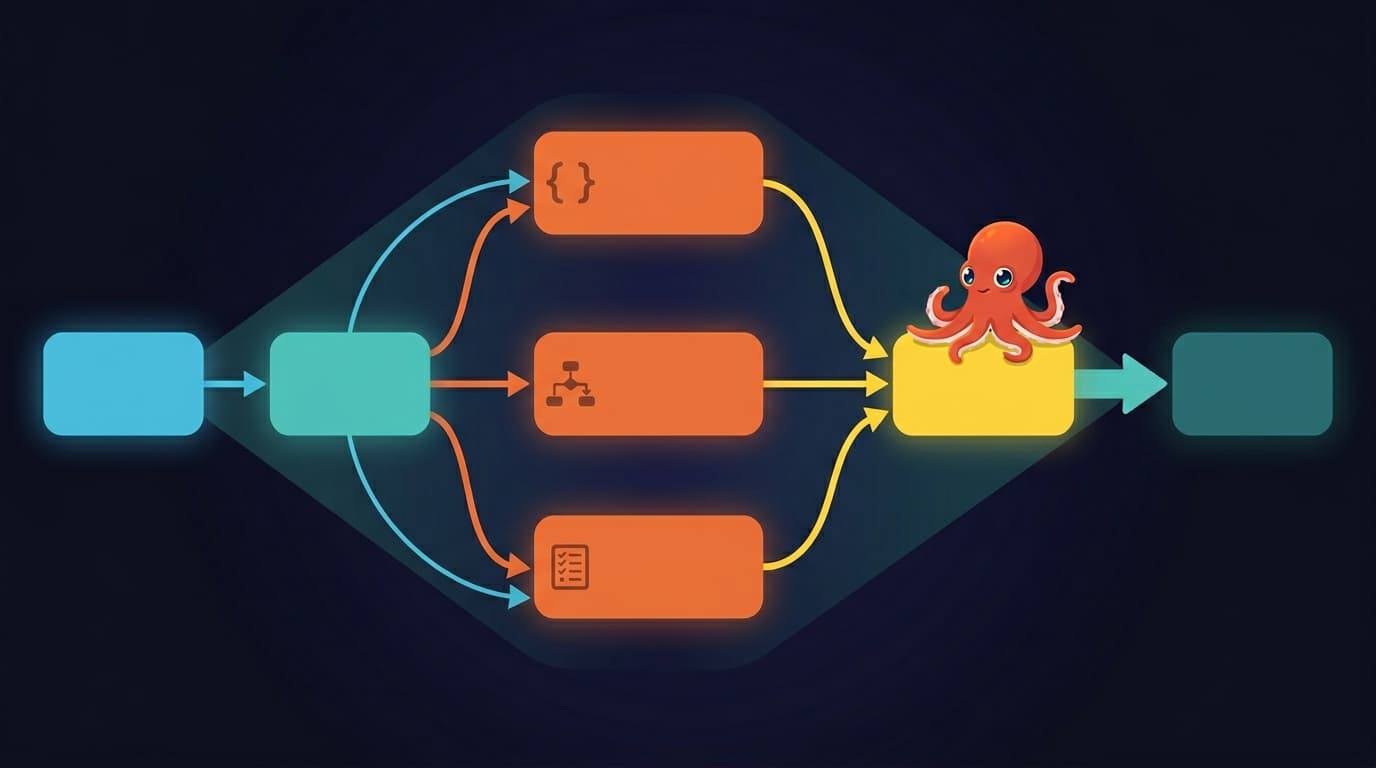
The governing constraint across all of these is stated directly in the manifest: "never change what code does, only how it does it." The simplification pass is not a refactor pass. It does not restructure logic, rename variables, split functions, or consolidate abstractions. Functionality is preserved. The output should be semantically identical to the input — testable against the same test suite, producing the same runtime behavior. The only thing that changes is surface-level structure.

The Conflict the Docs Don't Address
There is a problem specific to developers who already have code-simplifier installed, and it is not a hypothetical. The pr-review-toolkit plugin has been available long enough that teams who adopted it for review workflows now have the bundled version of code-simplifier in their environment alongside the v2.1.63 built-in /simplify.
Two separate implementations. No documented relationship between them. No documentation of which fires when you type /simplify in a session where both are present.
This matters because the implementations may diverge. Anthropic controls the built-in. The plugin version in the marketplace may be updated on a different schedule. If the underlying prompt changes in one but not the other, the two commands will produce different outputs from identical inputs. A team that relies on consistent simplification behavior across a codebase now has an undocumented variable in their workflow.
The fix is straightforward in principle: Anthropic documents the precedence rules, or merges the plugin into the built-in explicitly, or deprecates one in favor of the other. Until that happens, the two implementations coexist in an undefined relationship.
What /batch Doesn't Say
The traceable lineage that exists for /simplify does not exist for /batch. There is no corresponding plugin in the marketplace. The command appears in the v2.1.63 binary without a published antecedent.
Three days before the release, GitHub issue #28415 was filed against the claude-code repository. The request was specific: context inheritance across parallel Task calls. When Claude Code spawns subagents to execute independent operations simultaneously, each subagent starts with an isolated context. They share no state during execution. Results are aggregated after each task completes, not shared between tasks while they run. The issue author wanted a mechanism to coordinate context across those parallel executions — so that one subagent's findings could inform another subagent's behavior mid-run, not just at the output collection step.
The timing is a data point, not a proof. Anthropic may have already been building /batch while issue #28415 was open. The feature request may have shaped the implementation. The timing may be coincidence. I cannot distinguish between those possibilities.
What I can confirm: /batch shipped in the same release where context inheritance was the most recent explicit community request for parallel execution tooling. The command name is consistent with that request. A batch execution mechanism is a plausible solution to the problem the issue described. That chain of inference is coherent, and it is the only framework I have for interpreting /batch right now.
Any specific description of what /batch does when invoked — the syntax it accepts, how it handles context between operations, how it reports results, whether it processes a list of commands from a file — would be inference from the name and the adjacent feature request. That inference may be correct. It may not. I will not commit it to print as a mechanical description.

Why They Landed Together
/simplify and /batch shipped in the same version. The most natural reading of that pairing: one command improves code quality after a session's edits, the other executes multiple operations in sequence or in parallel during a complex session. Post-edit quality pass and execution throughput — adjacent problems, adjacent solutions, one release.
The alternative reading is scheduling. Two independent features completed development at the same time and landed together for unrelated reasons. The version number is not evidence of architectural relationship.
I prefer the paired reading, but the paired reading is still a hypothesis. Anthropic has not documented an intended workflow that sequences /simplify after /batch, or uses them as complementary tools. If such a workflow exists, it hasn't been described yet.
What the pairing does confirm: v2.1.63 was not a patch release. Two new interactive commands with distinct behaviors — one inherited from an existing plugin, one without precedent — represent a meaningful expansion of what developers can do within a session.
Where This Changes the Via Workflow
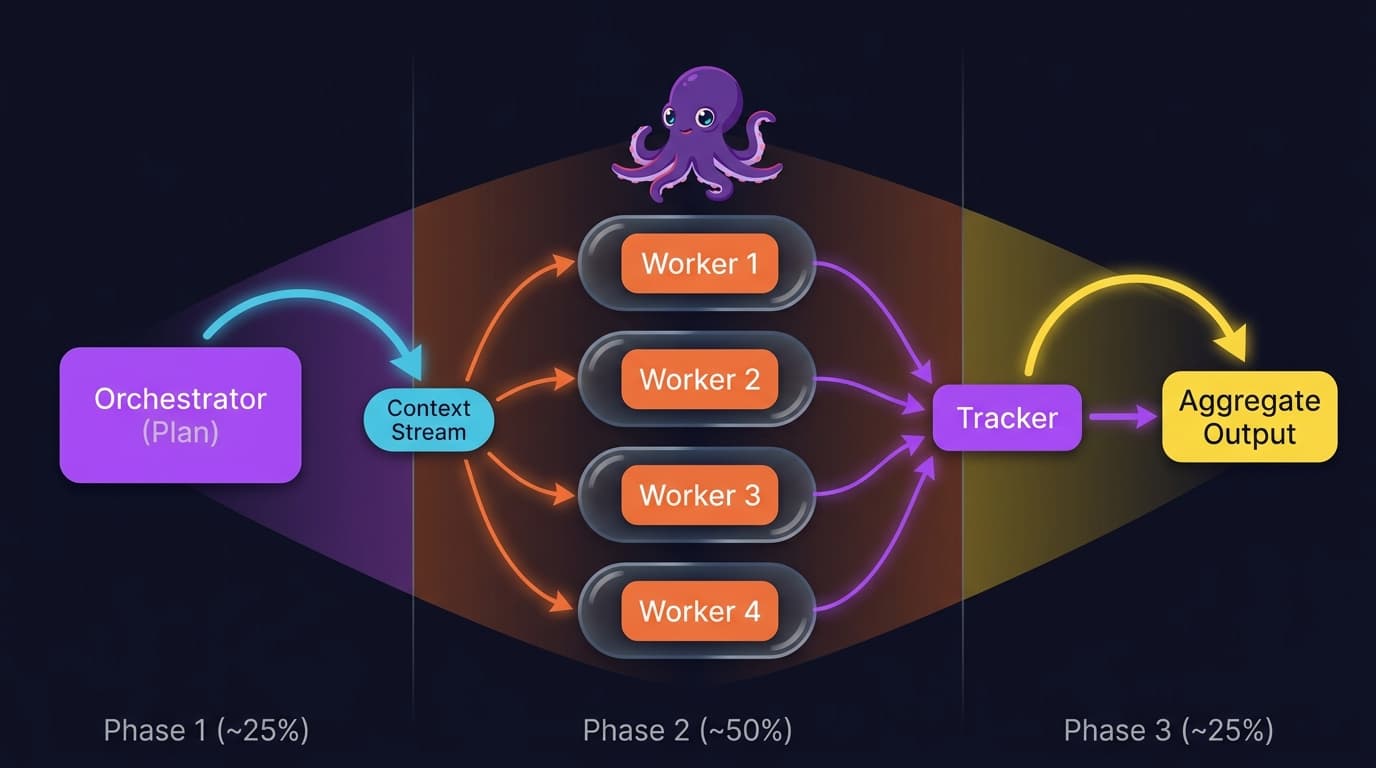
Via's orchestrator runs multi-agent missions across five domains. A typical research mission involves three to five parallel agents, each accumulating context independently. The orchestrator coordinates their output by aggregating results at the end of each phase, then re-injecting relevant context into the next phase when it starts. That re-injection step exists because there is no native mechanism for passing state between parallel executions mid-run. The orchestrator builds it manually: collect phase outputs, summarize what matters, write the summary into the next phase's starting context.
If /batch provides context inheritance across parallel tasks — if it is what issue #28415 requested — it is directly relevant to that workflow. The re-injection step is not complex code, but it adds latency to every phase boundary and is one of the places where context gets lost: the summarization that packages phase outputs for the next phase is necessarily lossy. A native mechanism for sharing state during execution would be more precise than a summary.
That is a significant if. I am describing what would change if /batch solves the problem issue #28415 named. I am not describing what /batch does.
/simplify is more immediately useful, and I can evaluate it with more confidence. Via's orchestrator generates TypeScript during missions — the plugin scaffold, the decision logic, the phase coordination code. That code passes through a code-generation agent and then goes into a review phase. The natural insertion point for /simplify is at the phase boundary between generation and review: after the generation agent completes, before the review agent reads its output.
The session-scoped behavior fits that insertion point. A phase boundary in Via corresponds to a natural session segment — the generation phase and the review phase run as distinct steps. If /simplify scopes to files modified in the current session, running it at the phase boundary means it touches exactly the files the generation agent just produced. No stale files, no unrelated code.
The CLAUDE.md integration is the detail I want to verify before relying on it. Via's CLAUDE.md is not a short document. It covers the orchestrator's decision patterns, the plugin schema, the naming conventions the codebase enforces, and the error handling approach for each major subsystem. If /simplify reads that file before it runs, the command has access to standards that would otherwise require explicit prompting. If the built-in's CLAUDE.md lookup is identical to the plugin's, the output should reflect Via-specific conventions rather than generic TypeScript defaults. That is worth testing against a real session before treating it as a production step.
The Opus model choice will affect cost accounting. Via tracks API costs per mission. A post-generation /simplify pass on a code-heavy phase would add Opus-tier cost to missions that currently run entirely on Sonnet. That cost delta needs to be measured against the quality improvement before the step gets added to the standard mission template.
Honest Limitations
The description of /simplify above is grounded in the plugin manifest, not in confirmed built-in behavior. The plugin and the built-in may implement the same logic, or they may have diverged between when the plugin was published and when v2.1.63 shipped. The CLAUDE.md lookup, the model choice, the session-scoping rule — all of these are inferred from the plugin documentation, which is the best available source but not a specification of the built-in.
The description of /batch is grounded in a name and a feature request filed three days before the release. I have no mechanical description to offer. The coincidence of timing is interesting. It is not ground truth.
The right next step is to run /simplify on a real Via code-generation session, document what it changes and what it skips, and check whether the CLAUDE.md lookup produces output that reflects Via-specific conventions. The post should be updated with those results. For /batch, the right move is to wait for the documentation to stabilize — issue #29504 was filed nineteen minutes after the release, and someone will write the docs eventually.
Two commands shipped before the docs. One I can partially describe. The other I cannot describe at all, which is itself a description of where the tooling is on the day it landed.
LEARNING: When a CLI ships commands without docs, the plugin marketplace is often the fastest path to ground truth — check whether the command has a published plugin antecedent before attempting to infer behavior from the name alone.
GOTCHA: If a developer has a plugin installed (e.g., code-simplifier) and the same command ships as a built-in, two separate implementations coexist with no documented precedence. This is a real ambiguity, not a hypothetical — any pr-review-toolkit user upgrading to v2.1.63 hits it.
FINDING: GitHub issue timing (3 days before release for /batch feature request) is a useful but non-conclusive signal — Anthropic was likely already building the feature while the issue was open. Do not treat temporal proximity as causal confirmation.
PATTERN: For articles where the subject is an undocumented tool release, the asymmetric treatment works — describe what you can verify with specificity, name what you cannot describe, and let the asymmetry itself carry the honest limitations section.