
At 10:47 AM on February 25, 2026, Noah Zweben — Claude Code's product manager — posted seven words that mass-obsoleted at least four startups: "Announcing a new Claude Code feature: Remote Control."
The feature itself is deceptively simple. Run claude remote-control in your terminal. A QR code appears. Scan it with your phone. Your local Claude Code session is now controllable from your pocket — same context, same files, same permissions. The terminal stays open on your machine. Your phone becomes a remote for it.
No code leaves your laptop. Anthropic's API routes messages between your phone and your local session over TLS, using short-lived scoped credentials. The execution environment never moves. Your machine runs the commands. Your phone sends the instructions.
Zweben's framing was not technical. "Take a walk, see the sun, walk your dog without losing your flow." That is a lifestyle pitch, not a feature announcement. It tells you exactly who Anthropic thinks is paying $100–$200 a month for Claude Max.
What I Heard When I Read It
I run Via — a personal intelligence system built on Claude Code — across 9 CLI plugins and 5 domains. The orchestrator decomposes missions into phases, each phase runs as a Claude Code session, and the whole thing executes locally on my machine. Budget queries, content publishing, intelligence gathering, note capture, task management. All terminal-native. All local.
When I saw Remote Control, I did not think "mobile coding." I thought: I can kick off a research mission from my couch and approve tool calls from the kitchen.
Via missions take anywhere from 3 to 45 minutes depending on complexity. A multi-phase content pipeline — scout news, select a story, capture notes, draft an article — can run for 20 minutes. During that time, the orchestrator periodically needs human input: approve a file write, confirm a publish target, unblock a permission prompt. Right now, that means staying within arm's reach of a terminal. Remote Control means I can start the mission, walk away, and handle approvals from my phone when they arrive.
This is not a theoretical workflow. I built two versions of it this week. On February 24, I ran a mission to build a Signal bot plugin — a Go daemon that polls a signal-cli-rest-api Docker container, parses incoming messages as CLI commands, executes them locally, and sends the output back as a Signal reply. The next day, I ran a second mission for an iMessage equivalent — same architecture, different transport, polling the Messages.app SQLite database and replying via AppleScript. Both work. Both let me text orchestrator status from my phone and get a response.
Remote Control shipped the same day the iMessage bot completed. The feature I spent two missions building across two days, Anthropic shipped as a product feature with session management, credential scoping, and a relay architecture I was never going to build well as a solo developer. My daemons poll every two seconds, crash on edge cases, and need a running Docker container or a macOS host. Anthropic's relay has an SRE team.
What Developers Should Hear
Remote Control is the first native mobile session continuity feature in the AI coding tool space. Cursor does not have it. Windsurf does not have it. GitHub Copilot does not have it. As of February 25, 2026, Claude Code is the only AI coding tool where you can start a session on your laptop and continue it from your phone without third-party bridges, VPN tunnels, or SSH wrappers.
That exclusivity will not last. Feature parity in this space moves in weeks, not quarters. But the architectural decision behind the feature — that is harder to replicate.
Here is the decision: your code stays on your machine.
Cursor and Windsurf are IDE-native. They run in desktop applications with embedded AI. Moving those sessions to mobile means either rebuilding the IDE for mobile (impractical) or moving execution to the cloud (which both are exploring). GitHub Codespaces already went cloud-native — your code runs on Microsoft's servers, full stop.
Claude Code chose the opposite direction. Terminal-native, local execution, no IDE. Remote Control extends that architecture to mobile without abandoning the local-first principle. Your machine is still the execution environment. The phone is a remote control, not a replacement.
This is a meaningful philosophical split in the AI coding tool market. On one side: cloud-first tools where your code runs on someone else's infrastructure, with the convenience and the dependency that implies. On the other: local-first tools where your machine is sovereign, with the power constraints and the privacy guarantees that implies.
The practical tradeoff is immediate. Remote Control requires your terminal to stay open. Close it, the session dies. Lose network for more than 10 minutes, the session dies. No backup, no recovery, no cloud snapshot to resume from. This is the cost of local execution — your machine is a single point of failure.
Cloud-native tools do not have this problem. GitHub Codespaces survives your laptop dying because your laptop was never the execution environment. The code was always on their servers. That is simultaneously the feature and the concern.
The Four Startups That Proved the Market
The most telling detail about Remote Control is not the feature. It is the timing.
In the six weeks before Anthropic's announcement, at least four independent developers posted Show HN projects solving the exact same problem:
| Project | Date | Approach |
|---|---|---|
| Anyware | ~Jan 7 | Attaches to local Claude Code session via managed VMs |
| Claude Code Remote (Phone) | ~Jan 15 | WebSocket bridge + PTY + xterm.js mobile wrapper |
| Claude Remote | ~Late Jan | Lightweight macOS bridge app, browser-based control |
| Claude Remote (Mac) | ~Feb 2026 | macOS app + browser, local execution only |
Four people, no coordination, different stacks, same problem. Each one built a relay between a local Claude Code session and a mobile or browser client because the native tool did not offer one.

This is convergent demand, not speculation. When four independent builders ship the same workaround in six weeks, the platform vendor is not innovating by shipping the native version — they are acknowledging a gap that the community already filled.
tekacs, commenting on the official Hacker News announcement thread, named the pattern directly: startups "pursuing simple intermediary roles" will get eaten when the major AI labs "imminently launch comparable functionality." The relay is a feature, not a company. Anthropic just proved it.
The projects that survive are the ones that abstract across vendors. claudecodeui, which deploys as a VPS-based development environment across multiple AI coding tools, is not displaced by Remote Control — because Anthropic cannot build multi-vendor abstraction for competitive reasons. The narrow relay projects are done. The multi-agent harnesses live.
The Enterprise Absence
Remote Control is available on Pro and Max plans. It is explicitly unavailable on Team and Enterprise plans.
This is the most strategically anomalous detail in the entire launch. Enterprise users represent more than half of Claude Code's revenue. Business subscriptions quadrupled since January 1, 2026. Anthropic closed a $30 billion Series G at a $380 billion valuation on February 12, largely on the strength of enterprise adoption. And the new feature that differentiates Claude Code from every competitor in the market is excluded from the tier that generates most of the money.
The likely explanation is unglamorous: enterprise security review, data governance certification, and audit requirements take longer than consumer feature launches. "Your code stays local" is architecturally true but contractually insufficient for a Fortune 500 compliance team. Remote Control routes messages through Anthropic's API, and while the code itself does not traverse those servers, message content — including tool outputs that may contain code snippets — does. For an enterprise CISO, "architecturally supportable" and "contractually guaranteed" are different conversations.
But there is a less obvious reading. Remote Control, as launched, is a power-user feature targeted at individual developers who treat Claude Code as a personal tool. The "walk your dog" framing, the Pro/Max tier targeting, the lifestyle pitch — all of it signals that Anthropic is building for the developer who pays their own subscription, not the developer whose company pays it.
That is a bet. A $2.5 billion annualized run-rate bet that the individual power user is a market worth designing for — even when the enterprise is where the revenue is today.
The Architectural Wager
Every AI coding tool is making an implicit bet about where code execution belongs. GitHub Codespaces bets it belongs in the cloud. Cursor and Windsurf bet it belongs in a desktop IDE. Claude Code bets it belongs in your terminal, on your machine, under your control.
Remote Control is the strongest expression of that bet yet. Anthropic could have shipped cloud-hosted Claude Code sessions accessible from mobile — and in fact they did, separately, with Claude Code on the Web. Remote Control is a different product with a different architecture and a different thesis: the developer's machine is the source of truth, and every other surface — phone, browser, tablet — is a window into it.
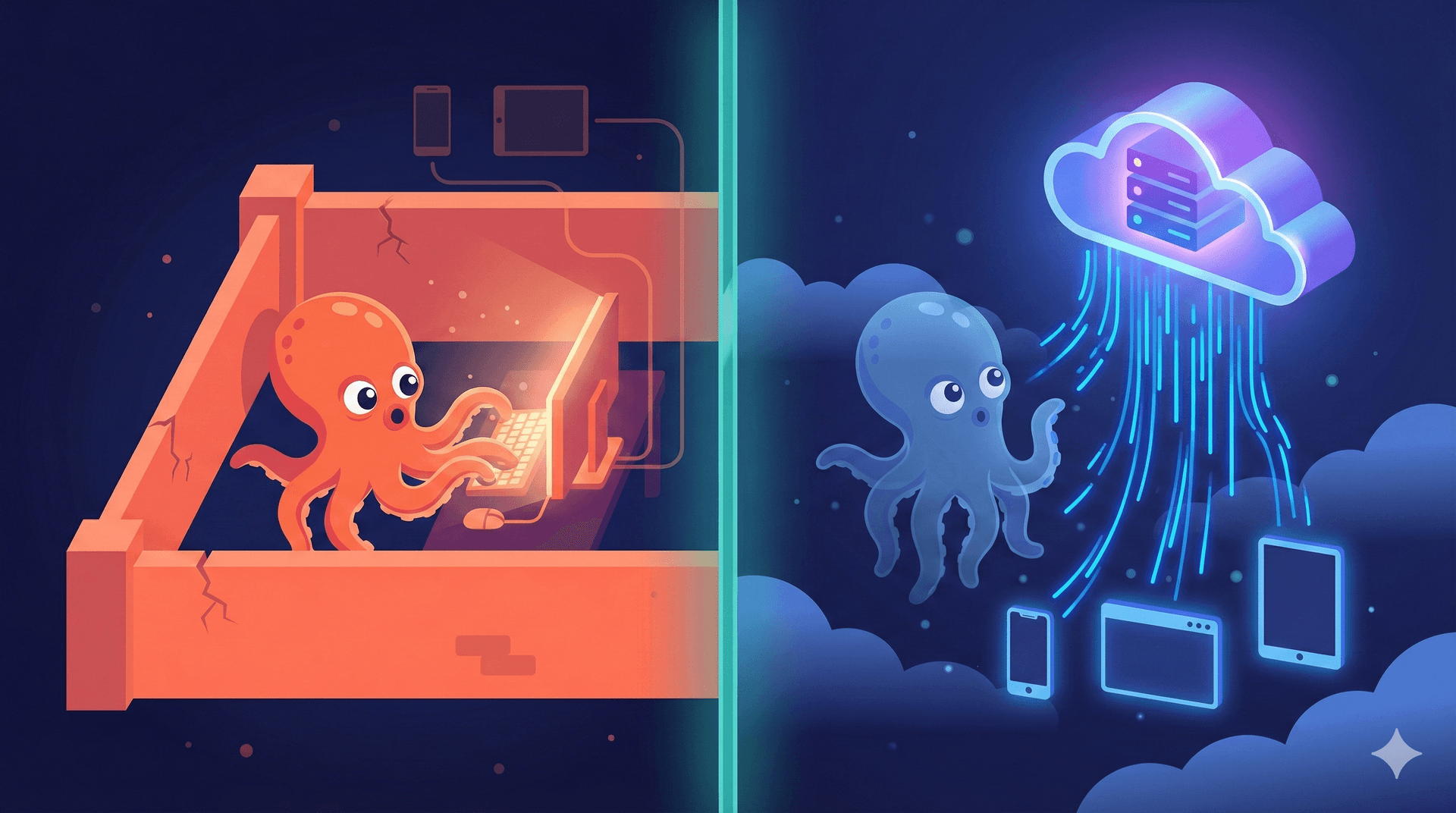
That thesis has a ceiling. Your machine has to stay on. Your network has to stay up. Your terminal has to stay open. Every one of those constraints is a failure mode that cloud-native tools have already solved by moving execution off your machine entirely.
It also has a floor. Your code never leaves your machine. Your execution environment is yours. No vendor lock-in to a cloud IDE. No data residency questions. No "what happens to my codebase if the company shuts down" anxiety. The floor is sovereignty, and for a specific kind of developer — the kind who runs 9 CLI plugins from their terminal and kicks off missions from their phone — that floor is worth the ceiling.
Anthropic is betting there are enough of those developers to matter. Four independent Show HN projects in six weeks suggest they might be right.
Honest Limitations
I have not used Remote Control. It launched today. Everything in this piece is based on documentation, the research brief, and architectural inference — not hands-on experience. The "walk your dog and approve tool calls" workflow I described is extrapolation from how I currently use Via, not a tested interaction pattern with the new feature.
The relay architecture introduces latency I cannot quantify. Polling-based message routing over HTTPS adds round-trip overhead that does not exist in a native terminal session. For short approvals — "yes, write that file" — the latency probably does not matter. For rapid back-and-forth debugging from a phone? I do not know. Nobody has published benchmarks.
I am also not a disinterested observer. I run Via on Claude Code. I pay for Max. I am precisely the power-user persona Zweben's announcement targeted. My enthusiasm for this feature is real and my objectivity about it is correspondingly suspect. The four Show HN projects are genuine market evidence. My personal excitement is not.